

Log in

Class 10 Case Study Based Board Questions

Standard Mathematics 2025

Case Study – 1

Rahul is a lucky charm for his cricket team. He has a jar of cards with numbers from 10 to 74. Before each match, he draws a card from the jar. If the card bears an even number, the team wins. If the number is even and divisible by 5, they win by a big margin. If the number is an odd number less than 30, they win by a small margin. And if the number is a prime number between 50 and 74, they lose.

Case Study Image

Answer the following questions:

  1. What is the probability that Rahul draws an even number?

  2. Step 1: Cards are numbered from 10 to 74.
    Step 2: Total number of cards
    = 74 − 10 + 1 = 65
    Step 3: Even numbers between 10 and 74 are:
    10, 12, 14, … , 74
    Step 4: Number of even numbers
    = (74 − 10) ÷ 2 + 1 = 33
    Probability = Favorable outcomes / Total outcomes
    = 33 / 65
  3. What is the probability that Rahul draws an odd number less than 30?

  4. Step 1: The cards are numbered from 10 to 74.
    Step 2: Total number of cards
    = 74 − 10 + 1 = 65
    Step 3: Odd numbers less than 30 between 10 and 74 are:
    11, 13, 15, 17, 19, 21, 23, 25, 27, 29
    Step 4: Number of odd numbers less than 30
    = 10
    Probability = Favorable outcomes / Total outcomes
    = 10 / 65
    = 2 / 13
  5. (a) Probability of prime number between 50 and 74

    Step 1: The cards are numbered from 10 to 74.
    Step 2: Total number of cards
    = 74 − 10 + 1 = 65
    Step 3: Prime numbers between 50 and 74 are:
    53, 59, 61, 67, 71, 73
    Step 4: Number of prime numbers between 50 and 74
    = 6
    Probability = Favorable outcomes / Total outcomes
    = 6 / 65

            OR
    (b) Probability of even number divisible by 5

  6. Step 1: The cards are numbered from 10 to 74.
    Step 2: Total number of cards
    = 74 − 10 + 1 = 65
    Step 3: Even numbers divisible by 5 are multiples of 10.
    Step 4: Multiples of 10 between 10 and 74 are:
    10, 20, 30, 40, 50, 60, 70
    Step 5: Number of even numbers divisible by 5
    = 7
    Probability = Favorable outcomes / Total outcomes
    = 7 / 65

Case Study – 2

A school is organizing a charity run to raise funds for a local hospital. The run is planned as a series of rounds around a track, with each round being 300 metres. To make the event more challenging and engaging, the organizers decide to increase the distance of each subsequent round by 50 metres. For example, the second round will be 350 metres, the third round will be 400 metres and so on. The total number of rounds planned is 10.

Case Study Image

Answer the following questions:

  1. Write the fourth, fifth and sixth term of the Arithmetic Progression so formed.

  2. Step 1: Distance of first round (a) = 300 m
    Step 2: Increase in distance each round (d) = 50 m
    Step 3: Formula for nth term of an A.P.
    an = a + (n − 1)d
    Step 4: 4th term = 300 + 3×50 = 450 m
    5th term = 300 + 4×50 = 500 m
    6th term = 300 + 5×50 = 550 m
    Fourth, Fifth and Sixth terms are:
    450 m, 500 m, 550 m
  3. Determine the distance of the 8th round.

  4. Step 1: First term (a) = 300 m, Common difference (d) = 50 m
    Step 2: Formula for nth term
    an = a + (n − 1)d
    Step 3: 8th term = 300 + 7×50
    Step 4: = 650 m
    Distance of the 8th round = 650 metres
  5. (a) Find the total distance run after completing all 10 rounds.

    Step 1: a = 300 m, d = 50 m, n = 10
    Step 2: Formula for sum of n terms
    Sn = n/2 [2a + (n − 1)d]
    Step 3: S10 = 10/2 [2×300 + 9×50]
    Step 4: = 5 [600 + 450] = 5×1050
    Total distance run = 5250 metres

           OR
    (b) If a runner completes only the first 6 rounds, what is the total distance run by the runner ?

  6. Step 1: a = 300 m, d = 50 m, n = 6
    Step 2: Formula for sum of n terms
    Sn = n/2 [2a + (n − 1)d]
    Step 3: S6 = 6/2 [2×300 + 5×50]
    Step 4: = 3 [600 + 250] = 3×850
    Total distance run = 2550 metres

Case Study – 3

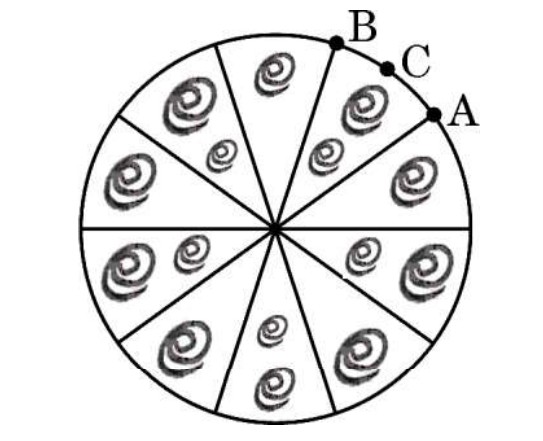
A brooch is a decorative piece often worn on clothing like jackets, blouses or dresses to add elegance. Made from precious metals and decorated with gemstones, brooches come in many shapes and designs. One such brooch is made with silver wire in the form of a circle with diameter 35 mm. The wire is also used in making 5 diameters which divide the circle into 10 equal sectors as shown in the figure.

Case Study Image

Answer the following questions:

  1. Find the central angle of each sector.

  2. Step 1: The circle is divided into 10 equal sectors.
    Step 2: Total angle at the center of a circle = 360°.
    Step 3: Central angle of each sector
    = 360° ÷ 10
    Central angle of each sector = 36°
  3. Find the length of the arc ACB.

  4. Step 1: Diameter of the circle = 35 mm
    Step 2: Radius (r) = 35 ÷ 2 = 17.5 mm
    Step 3: Arc ACB covers 3 sectors
    Central angle = 3 × 36° = 108°
    Step 4: Formula for arc length
    = (θ / 360) × 2πr
    Step 5: = (108 / 360) × 2 × (22/7) × 17.5
    Length of arc ACB = 33 mm
  5. (a) Find the area of each sector of the brooch.

    Step 1: Radius (r) = 17.5 mm
    Step 2: Central angle of one sector = 36°
    Step 3: Formula for area of a sector
    = (θ / 360) × πr²
    Step 4: = (36 / 360) × (22/7) × (17.5)²
    Area of each sector = 96.25 mm²

           OR
    (b) Find the total length of the silver wire used.

  6. Step 1: Radius of the circle = 17.5 mm
    Step 2: Circumference of the circle
    = 2πr = 2 × (22/7) × 17.5 = 110 mm
    Step 3: Number of diameters used = 5
    Step 4: Length of one diameter = 35 mm
    Step 5: Total length of diameters
    = 5 × 35 = 175 mm
    Total length of silver wire used
    = 110 + 175 = 285 mm

Case Study – 4

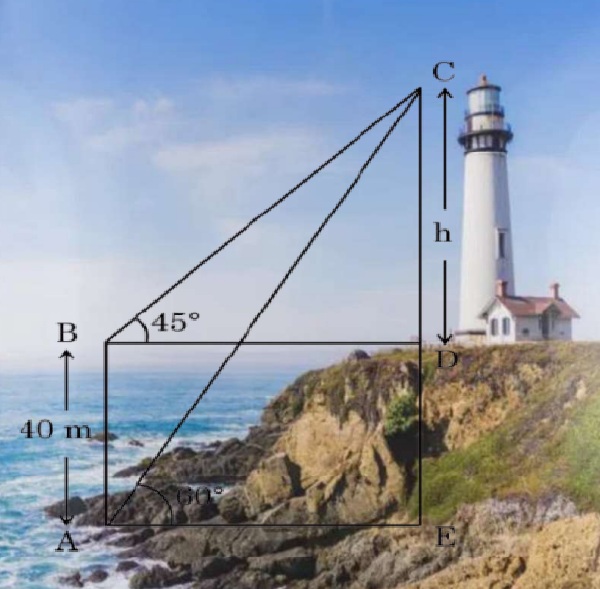
Amrita stood near the base of a lighthouse, gazing up at its towering height. She measured the angle of elevation to the top and found it to be $60^{\circ}$. Then, she climbed a nearby observation deck, 40 metres higher than her original position and noticed the angle of elevation to the top of lighthouse to be $45^{\circ}$ .

Case Study Image

Based on the above given information, answer the following questions :

  1. If $ CD$ is $ h$ metres, find the distance $ BD$ in terms of $'h'$.

  2. Step 1: At point B, angle of elevation to the top of lighthouse = 45°.
    Step 2: In right-angled triangle BDC,
    tan 45° = CD / BD
    Step 3: Since tan 45° = 1,
    1 = h / BD
    BD = h metres
  3. Find distance $ BC$ in terms of $'h'$.

  4. Step 1: From the figure,
    $ BC^2 = BD^2 + DC^2$
    Step 2: From Question 1,
    BD = h and DC = h
    $ BC = \sqrt{h^2 + h^2}$ = $\sqrt{2}h $metres
  5. (a) Find the height $ CE$ of the lighthouse [use $\pi=1.73$]

    Step 1: At point A, angle of elevation = 60°.
    Step 2: In right-angled triangle ACE,
    tan 60° = CE / AE
    Step 3: tan 60° = √3 = 1.73
    Step 4: From the figure,
    AE = BD = h
    Step 5:
    CE = 1.73 × h
    Height of the lighthouse, CE = 1.73h metres

           OR
    (b) Find distance $ AE$, if $ AC = 100~ m$.

  6. Step 1: In triangle ACE,
    AC² = AE² + CE²
    Step 2: Given:
    AC = 100 m
    CE = 1.73h
    Step 3:
    100² = AE² + (1.73h)²
    Step 4:
    10000 = AE² + 2.99h²
    AE = √(10000 − 2.99h²) metres

Case Study – 5

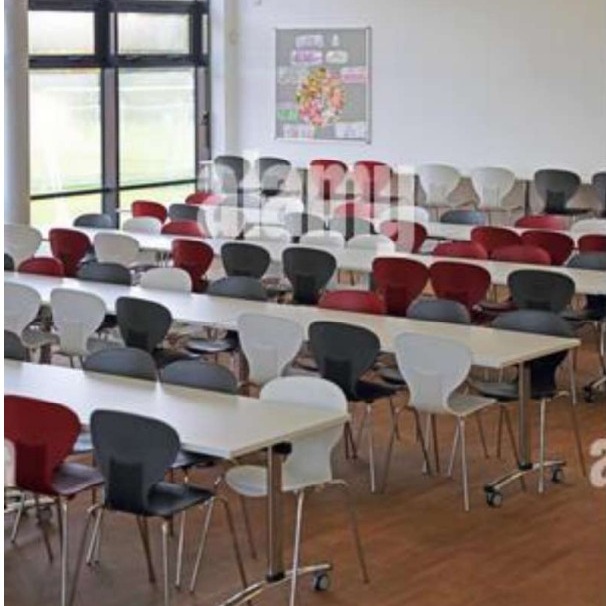
A school is organizing a grand cultural event to show the talent of its students. To accommodate the guests, the school plans to rent chairs and tables from a local supplier. It finds that rent for each chair is ₹50 and for each table is ₹200. The school spends ₹30,000 for renting the chairs and tables. Also, the total number of items (chairs and tables) rented are 300.

Case Study Image

If the school rents 'x' chairs and 'y' tables, answer the following questions :

  1. Write down the pair of linear equations representing the given information.

  2. Step 1: Let the number of chairs rented be $$x$$ and the number of tables rented be $$y$$.
    Step 2: Total number of items rented = 300
    $$x + y = 300$$
    Step 3: Rent of each chair = ₹50
    Rent of each table = ₹200
    Step 4: Total rent = ₹30,000
    $$50x + 200y = 30000$$
    Required pair of linear equations:
    $$x + y = 300$$ $$50x + 200y = 30000$$
  3. What is maximum number of tables that can be rented in ₹ 30,000 if no chairs are rented ?

  4. Step 1: If no chairs are rented, then:
    $$x = 0$$
    Step 2: Rent per table = ₹200
    Total amount = ₹30,000
    Step 3:
    $$200y = 30000$$
    Step 4:
    $$y = \frac{30000}{200} = 150$$
    Maximum number of tables = 150
  5. (a) Find the number of chairs and number of tables rented by the school.

    Step 1: Given equations:
    $$x + y = 300 \quad (1)$$ $$50x + 200y = 30000 \quad (2)$$
    Step 2: Divide equation (2) by 50:
    $$x + 4y = 600 \quad (3)$$
    Step 3: Subtract equation (1) from equation (3):
    $$(x + 4y) - (x + y) = 600 - 300$$
    Step 4:
    $$3y = 300 \Rightarrow y = 100$$
    Step 5: Substitute $$y = 100$$ in equation (1):
    $$x + 100 = 300 \Rightarrow x = 200$$
    Number of chairs = 200
    Number of tables = 100

           OR
    (b) If the school wants to spend a maximum of ₹ 27,000 on 300 items (tables and chairs), then find the number of chairs and tables it can rent.

  6. Step 1: Let number of chairs = $$x$$ and number of tables = $$y$$.
    Step 2: Total items:
    $$x + y = 300$$
    Step 3: Maximum total cost:
    $$50x + 200y = 27000$$
    Step 4: Divide second equation by 50:
    $$x + 4y = 540$$
    Step 5: Subtract first equation:
    $$(x + 4y) - (x + y) = 540 - 300$$
    Step 6:
    $$3y = 240 \Rightarrow y = 80$$
    Step 7:
    $$x = 300 - 80 = 220$$
    Chairs = 220
    Tables = 80

Case Study – 6

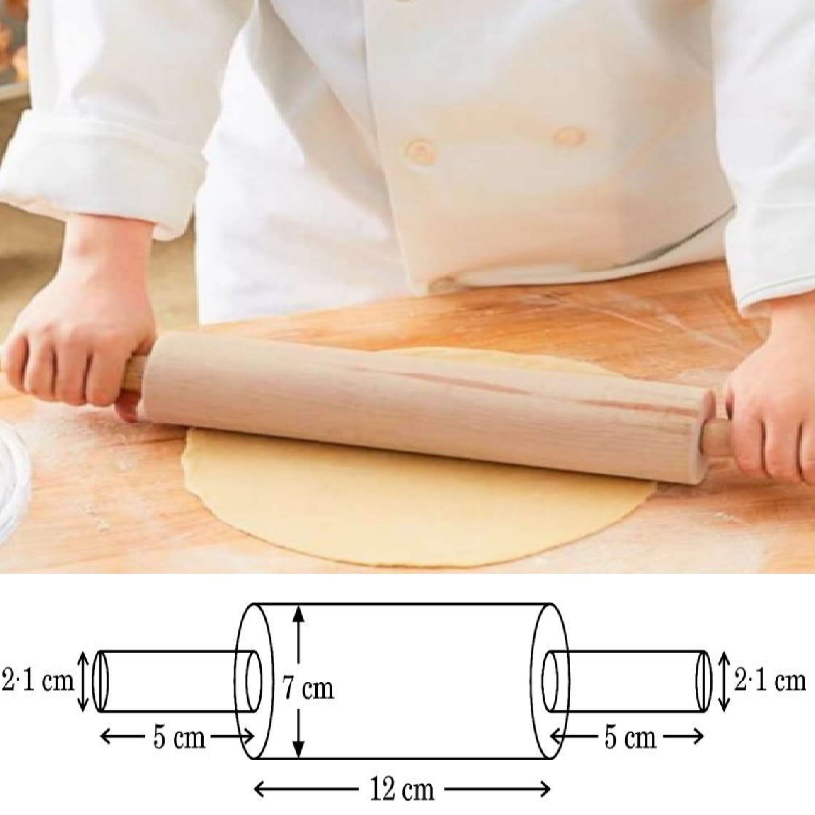
A skilled carpenter decided to craft a special rolling pin for the local baker. He carefully joined three cylindrical pieces of wood two small ones on the ends and one larger in the centre to create a perfect tool. The baker loved the rolling pin, as it rolled out the smoothest dough for breads and pastries.
The length of the bigger cylindrical part is 12 cm and diameter is 7 cm and the length of each smaller cylindrical part is 5 cm and diameter is 2.1 cm.

Case Study Image

Based on the above information, answer the following questions :

  1. Find the volume of the bigger cylindrical part.

  2. Step 1: Diameter of bigger cylinder = $$7\text{ cm}$$
    Radius $$r = \frac{7}{2} = 3.5\text{ cm}$$
    Step 2: Height (length) of bigger cylinder = $$12\text{ cm}$$
    Step 3: Formula for volume of a cylinder:
    $$V = \pi r^2 h$$
    Step 4:
    $$V = \frac{22}{7} \times (3.5)^2 \times 12$$
    Volume of the bigger cylindrical part = 462 cm³
  3. Find the curved surface area of the bigger cylindrical part.

  4. Step 1: Radius $$r = 3.5\text{ cm}$$, Height $$h = 12\text{ cm}$$
    Step 2: Formula for curved surface area:
    $$\text{CSA} = 2\pi rh$$
    Step 3:
    $$\text{CSA} = 2 \times \frac{22}{7} \times 3.5 \times 12$$
    Curved surface area of the bigger cylindrical part = 264 cm²
  5. (a) Find the ratio of the volume of the bigger cylindrical part to the total volume of the two smaller (identical) cylindrical parts.

    Step 1: Diameter of smaller cylinder = $$2.1\text{ cm}$$
    Radius $$r = \frac{2.1}{2} = 1.05\text{ cm}$$
    Step 2: Height of each smaller cylinder = $$5\text{ cm}$$
    Step 3: Volume of one smaller cylinder:
    $$V = \pi r^2 h$$
    $$= \frac{22}{7} \times (1.05)^2 \times 5 = 17.325\text{ cm}^3$$
    Step 4: Volume of two smaller cylinders:
    $$= 2 \times 17.325 = 34.65\text{ cm}^3$$
    Step 5: Volume of bigger cylinder = $$462\text{ cm}^3$$
    Required ratio = $$462 : 34.65 = \boxed{40 : 3}$$

           OR
    (b) Find the sum of the curved surface areas of the two identical smaller cylindrical parts.

  6. Step 1: Radius of smaller cylinder $$r = 1.05\text{ cm}$$
    Height $$h = 5\text{ cm}$$
    Step 2: Curved surface area of one smaller cylinder:
    $$\text{CSA} = 2\pi rh$$
    Step 3:
    $$= 2 \times \frac{22}{7} \times 1.05 \times 5 = 33\text{ cm}^2$$
    Step 4: Curved surface area of two smaller cylinders:
    $$= 2 \times 33$$
    Sum of curved surface areas = 66 cm²